Pages

Tuesday, August 8, 2017

Monte Alban - Another City, Another Ruin

It felt good to be on the move again.  The toll road from Puebla to Oaxaca City was surprisingly smooth for the most part.  It ran first through long valleys of brilliant emerald green south of Puebla, miles of fertile farmland still dominated by the sky-carving blue silhouette of the La Malinche volcano.  Then it spun up into a belt of rounded dry mountains, on switchbacks cutting through crumbly bluffs of yellow and red rock with vistas of a sea of hills tinted in pale thorny vegetation. 


In about five hours I was entering the ugly urban outskirts of Oaxaca City.  Fortunately, I’m familiar with the pattern: as my Google Maps navigation brought me closer to the center of town, the streets got narrower, the architecture more charming, the old churches more plentiful.  My hostel was close enough to the city center that I felt okay leaving my Miata parked on the street outside.

I’m staying at the Cielo Azul hostel, a rambling place whose buildings are strung around a charming central courtyard full of plants and patio tables.  It’s so rambling, in fact, that the bathroom is quite a long outdoor walk from the dormitory, and the wi-fi only reaches the reception side of the compound.  There are plenty of other travellers here, many of whom speak English, but this is the first real “youth hostel” I’ve stayed at; everyone is in their 20s and I feel out of place, unable to join conversations. 


But that’s all right.  This is just a stop-over point: I’m burned out on cities and am eager to head on to the beaches.  Oaxaca City strikes me as a bargain-basement Puebla anyway: the streets are a little more run-down, the shops a little poorer, the central square a little shabbier.  I definitely feel that I’m further South.

However there’s one “must-see” attraction here, and that’s the ruins of Monte Alban, in the mountains above town.  I signed up for a tour of it yesterday; a van picked me up in the morning at the hostel; the driver stopped at several other hotels in town and by the time he drove up into the mountains we had a group of about a dozen people.  The guide who met us at the site, a pot-bellied fellow with sunglasses, was adept in giving his talk in two languages at once, and I was able to learn a bit of the history, about the Zapotec people (who still make up 24% of Oaxaca State’s population), the discovery of the site in 1931 by archaeologist Alfonso Caso, the “Oac” tree after which the State is named, the local variations of the ball game played in the ancient city, its contacts with the people of Teotihuacan.  After about an hour moving the large group from shade patch to shade patch, in the train of other large groups, we split up for free time to wander the site at will.

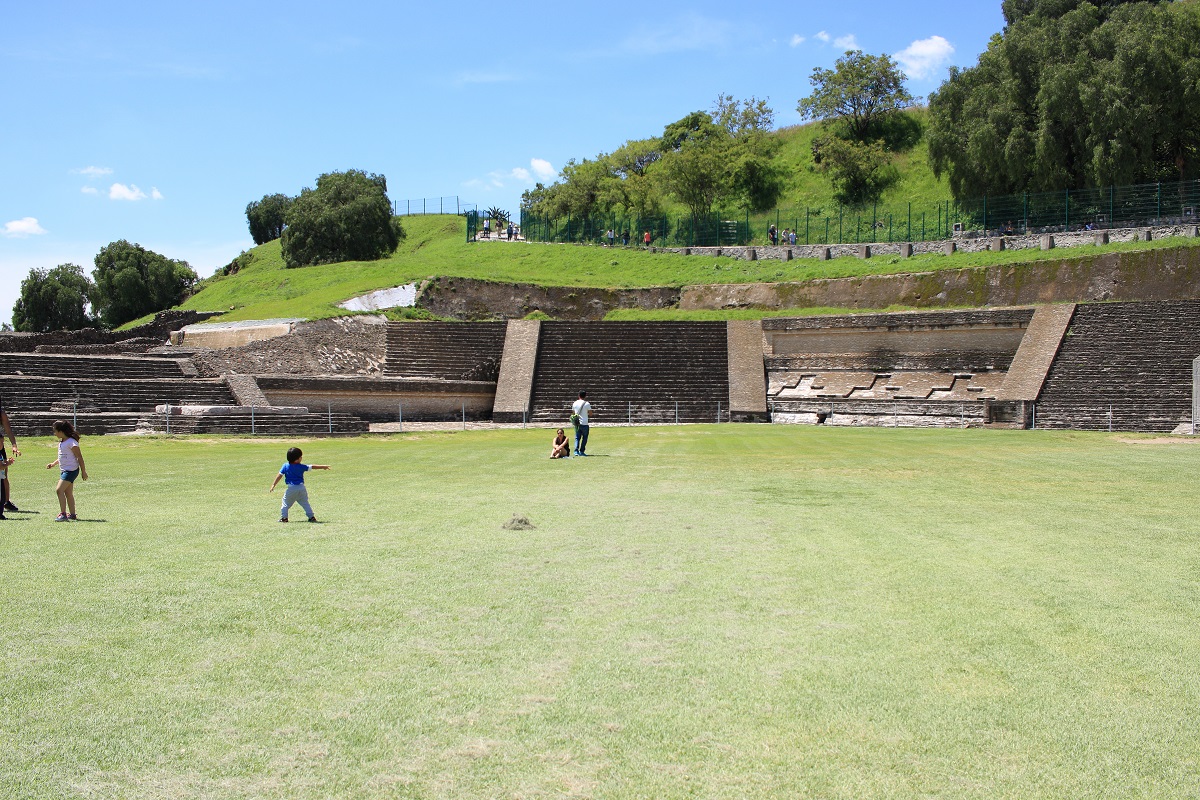
The great feature of Monte Alban is its size.  The city was created by leveling off the whole top of its mountain: the resulting flat grass plateau is vast, and the several pyramids anchoring it it like gargantuan building blocks utterly dominate the tiny figures of the tourists wandering below.  From a camera point of view these figures were excellent at establishing scale, though I wished I had wide-angle lens to really drive home the point.


I’ve come to the conclusion that one of the most appealing aspects of Mexico’s ancient ruins is their blend of massive architecture and grassland.  The grass is a modern addition of course, helpfully provided by nature and weedwhacked by the government, and Monte Alban in particular seems to be a perfect aesthetic blend of meadow, knoll, and temple stone.  It’s surprisingly pleasant to stroll a wide flat lawn looking up at great edifices emerging from moss and trees, to wander among them and climb their stone stairs for interesting views and a fresh country breeze.  I think modern cities should take a cue from these ruins.  Why shouldn’t soil, grass, trees and hills be the foundation of our own urban spaces?  I think the whole thing is applicable.


Sunday, August 6, 2017

The Cholula Pyramid and Authenticity

Yesterday I took a day tour from Puebla to see the “Pyramid” of Cholula.

Don’t expect much in the way of description for Puebla, gem of the Mexican guidebooks as it may be.  I cruised in and out with barely a glance and a lot on my mind.  I wore out the stone sidewalk for the three blocks between my hotelroom and the city center where the necessary restaurants and coffeehouses were clustered, and didn’t have the time to look further.  Also in the Centro, I did notice, was a mighty 16th Century cathedral, a stroll inside of which (where photos were prohibited) revealed such a hangarspace worth of Baroque overdecoration that its astrally gilded dome could encompass a pillared cupola that itself could have contained my town church in Cornwall Connecticut.  At night, as I emerged strung out on caffeine from an all-day coffeehouse stint writing three blog posts, the cathedral was staging a music and light show in which they projected tie-dye colors, spinning pinwheels, shadow-forms of wing-flapping angels, and a melting Mexican flag on the ancient stone.  I didn’t approve.  But never fear, there were plenty of other grand old churches to choose from: in my immediate neighborhood there were at least five, and so many colonial buildings done up in pink-and-white zig-zag tile that you couldn’t use them as landmarks.

My memories of Puebla will likely be restricted to my bizarre hotel, the Meson San Sebastian.  From the street you enter a luxurious two-story flagstone courtyard, pillared and arched in creamy yellow and filled with plants, glass doors and patio tables.  But my room upstairs?  It had no lock on the door; instead they issue you a padlock and its key, which I could affix to the latch either inside or outside the door to close it.  The room had no windows, a very dim hanging ceiling light, and no desk; one of the frosted glass panels on the door was broken and Scotch-taped shut, and the toilet pull-chain broke while I was there.  But it had palatially high ceilings of old wooden beams, and rich red curtains that one pulled in front of the door at night to shut out the hall light, and the bed was comfortable.  It was essentially an aristocratic cell.


My padlock

I put “pyramid” in quotes because it isn’t one, or wasn’t one, or is or was several, or maybe none.  Whatever structure was there was abandoned circa 1100 and immediately overgrown, and by the time the Spaniards arrived even the natives thought of it as a green hill, an illusion that persevered well into the 20th Century (despite Porfirio Diaz running railroad tracks through part of it in the 19th).  When archeologists finally started acknowledging an underhill edifice their hyperbolic verdict apparently announced no less than four ancient pyramids one on top of the other dating back to 250 BC, with a total base circumference by far exceeding the previous earthly record-holder, notwithstanding which hoopla it has never been excavated and to this day presents to the eye the aspect of a green hill (with a colonial-era church on top).

I received this information from Carla, a petite and energetic brown-haired native tour guide walking between the seats on a huge tinted-window tour bus that pulled away from the curb in the Pueblo Centro with all of four tourists aboard.  Puebla apparently runs these things like subway cars, on a daily schedule no matter how few people sign up.  Because of me—and because the Mexican couple sat rows away—Carla was forced to deliver her lecture in two languages (Amit, the bearded young backpacking Israeli, being fluent in Spanish), but she handled it admirably, the more so because I had no interest in the pyramid, but was hoping only to get a good view of Popocatepetl from Cholula.  I got my first teaser view of the famous volcano from the bus window en route.


En route to the pyramid we stopped briefly at two of Cholula’s churches (as if Puebla hadn’t had enough).  The first was the Iglesia de San Francisco Acatepec, another example of that curious Mexican over-candied pullulation of ornament that bowls one over from a distance but, up close reveals itself to be a medley of sadly cartoonish babies.


Carla did explain, on her own, that if the interior appears somehow sup-par it’s because the whole thing is a reconstruction following a 1939 fire; one can stand at a roped-off door and see at the back of an alcove a tiny piece of the 16th Century original that survived (its cherub looked more aesthetically finished).

The second church was a local landmark called Tonantzin, noted because its exterior features images of saints with brown skin, a liberty apparently granted to the Indian builders so that their exploited race (which Carla referred to as “we”) could more readily identify with their religious overlords. 


The imagery was again primitive to my taste, which I tried conscientiously to expand, but when I admired the group of figures playing musical instruments Carla admitted that that whole section was a modern addition.

The pyramid is, it’s true, partially excavated, but its most impressive wall—which  one encounters first, walking the long tourist promenade from the big parkinglot hosting several tour buses—is a fake, commissioned by the government to lend popular validity to the mostly invisible site.

This part of the pyramid is fake

The vast majority of the Zona Archeologico is indeed still mostly a green hill, and we—I was circling it in company with Amit—were now newly cynical, distrusting any revealed block that looked too smooth or white.  At least there was a view of Popocatepetl in the other direction.


You can, however, quickly learn to appreciate modern engineering by taking the underground tour.  This follows a series of tunnels cut into the pyramid by the various archeology teams to, I believe, initially verify that it wasn’t just a hill.  In my search for authentic stone I momentarily forgot that I don’t like being underground in small spaces; once in, there was nothing for it but to inch forward in an endless single file of tourists through an arch-shaped tunnel into the earth barely head-high and too narrow for anyone to turn around and squeeze backward.  I tried to breathe steadily whenever the Japanese group ahead brought the whole line to a stop for selfies.  And I never loved electric lights, sturdy metal floors, and ventilation so much.  To be fair, I think that even those without my affliction would find the unvaried stone to either hand uninteresting.

What is authenticity?  What makes an original “better” than a copy?  If we, uneducated laymen, can’t tell the difference, why does it matter?  Given that history, and perhaps all of culture, is a story we tell ourselves, why shouldn’t we—edit it? 

I think it all boils down to expectations.  We visit an ancient ruin to experience a window to the past, and we want to see the past.  If it isn’t the past, it’s a fraud.  We look at a famous painting to experience supreme artistic creativity; if it’s a copy—if it’s not creative—it’s likewise not what we paid to see.  In contrast, the replica of “Lucy” at the National Museum of Anthropology didn’t bother me, because its purpose in the room was to illustrate the idea of evolution, along with the various dioramas; I wasn’t told it was the original.

Mexico is a country bubbling in a constant convection with its own pasts, wrestling with its depredations, interpreting its victimizations, wary of the “authentic” in ethnicity and worship, honoring its ancient stone as it boasts of its steel and glass, unleashing every kind of constructive and destructive creativity in an effort to stitch its fractured national story together.  Maybe what we think of as the genuine is only the unifying fiction most victorious in the bloody marketplace of ideas.  It was a long climb from the tunnel mouth to the church at the top of the hill, and Amit and I didn’t have much time before the tour bus left.  But from there one could at last clearly see the unimpeachably, the perfectly, the beautifully and eternally authentic:


Ironic that it’s a dangerous volcano, currently closed because it’s too active.


Friday, August 4, 2017

A Day in Tepoztlán - Hike to Tepozteco / the Dominican Ex-Convent

The town of Tepoztlán, where I spent two nights and a day at the home of my friend Adrian Smith, is a small colonial-era village nestled in a spectacular mountain setting, about an hour South of Mexico City.

The dramatic mountains of Tepoztlán seen from
the mirador of the Dominican Ex-Convent

It’s listed as a “Pueblo Magico,” one of Mexico’s officially charming towns, but its hold on the certificate has been slippery, perhaps reflecting my feeling that its charm was skin deep.  Like many colonial towns or neighborhoods it features narrow, cobbled streets (nightmarish for traffic or low-slung cars), fronted on each side by a lineup of colorful shops and enticing restaurants, with, in the center, a beautiful central plaza around a venerable church (in this case a Dominican ex-convent).  As the town rises toward the foothills the streets become rockier and steeper, and they’re not short on hanging flowers and pretty perspectives, especially with that green-clad cliff-lifted wall of mountains ever in the background.  But a closer look reveals that many of the buildings are of cheap cement-block or brick construction, and overall I felt a dusty pall of makeshift poverty hovering behind the facades.


That didn’t stop it from being a wonderful place to stay and to explore.  It helped that with Adrian’s guidance I was taken to some of the loveliest restaurants, like La Miga in a shady garden of ranch-style buildings where everyone seemed to be friends, or El Corazon de Mexico with its outdoor tables rocking on the cobblestone courtyard and its tasty Mole dishes.  On our first evening we stumbled into an event in the town square where a festive crowd was setting aloft a homemade fire balloon.


Tepozteco

But the star attraction of the town, which occupied most of my full day there, is Tepozteco, a small Aztec temple high in the mountains, reached by a steep and arduous hike on a trail that starts a mile or so North of town.

I began my hike in the morning, walking uphill through the narrow streets, helpfully guided by signs for the pyramid.  The trail got progressively more primitive from there: starting in a leafy enfilade of last-chance vendors, it climbed through the greenery first in well-built stone stairways; then, more steeply, in narrow tracks of broken rock where you had to place your feet carefully; finally, funneled into the last niche-like gorge, straight up on a system of metal ladders hammered into the rock.


The tourists were plentiful, and at 7,000 feet the combined gasping added humidity to the hot jungle around us.  But every step was accompanied by the relief of gorgeous patterns of sun and green shade and, above and below, appalling vistas of the rock-clawed shafts of the mountain from black gorges to sun-laureled brows.  And finally (ta-ra!) the temple appeared.


The pyramid was relatively small, a mountain-ridge fort easily clambered, but the view from it was large, to say the least.


It was worth staying for a while, in the welcome breeze, before essaying the long downward trail.

The Dominican Ex-Convent


After lunch back in town (where hopefully my sweaty presence didn’t disturb the colorful Mexican ambience) I headed over to the main church, the Dominican ex-convent or Parroquia Nuestra Señora de la Navidad.  Its entrance boasts some lovely bas-relief figures and Dominican insignias, and inside one finds a typically tranquil convent courtyard of white arches around a central fountain—a pleasant place to rest my still-sore feet, with a rare corner vantage suitable for self-timer photos.


The convent, like others I’ve seen, has restored its once-covered trove of original 16th-Century wall decorations—in this case curious patterns featuring the heads of kings in (and extending from) floral designs.  I’m not sure what to make of those.


But in Tepoztlán everything leads back and up to the mountains, and the highlight of the church was its mirador room, an open-air gallery whose arched windows framed the eternal green glory of the landscape.


There was a gentleman occupying the mirador with a telescope pointed at the Tepozteco pyramid, from here a microscopic square breaking the cauliflower crust of the distant jungly ridge.  I didn’t need to look. 

Mexico City: Ring Around the Alameda

What?  Back in Mexico City?  Didn’t I finally leave in my last post?

Yes, but what with travel plans, travel, and sundry Internet outages this blog has fallen way behind, and I would be doing Mexico City and my local friend Brett Duel an injustice if I didn’t go back and fill in the excellent day we spent together knocking off a grand slam of further museums around the Alameda.

The Alameda is a large rectangular “park” downtown near the Historical Center; I put “park” in quotes because it’s so overly-interlaced with paths, missiled about with tall statues, colonized with happy parents and their multiplying spawn, and overshadowed by mighty and portentous buildings on all sides that it seems a mere frizz of pale green in the urban flux.  I met Brett at its largest feature, the pillared white marble semicircle devoted to Benito Juarez, who in death has risen even higher from his peasant origins to sit a lofty plinth, flanked by marble lions at the base, in company with two Gibson girls from the kind of Art Nouveau afterlife that makes me wish I’d been a famous statesman.

I’m such a sucker for allegorical Art Nouveau Gibson Girls

The Semicircle below

From eternal posthumous grandeur we went straight to eternal posthumous grieving.  We started with the Memory and Tolerance museum, the institution devoted to human genocides.  (I had been there before but bought the wrong ticket and missed the main exhibits; Brett had never been.)  The main exhibit was about the Holocaust, and the museum’s presentation was very...I suppose the right word is effective.  I would encourage anyone to go.  Photographs were permitted and I had my camera ready, but I took no shots, partly because the rooms were deliberately dark, partly because the most powerful elements of the display were already photographs.  Some you’ve seen, many you haven’t.  These precious documents of heartlessness beyond comprehension were such that Brett and I wondered whether the photographers themselves had to be equally heartless to press the shutter, or great-hearted beyond consequence.  At any rate we can only thank them.

The museum then had rooms for other genocides, from Armenia to Rwanda to Nicaragua, driving home a message that we’ve learned nothing, a message emphasized by the final “Tolerance” section which was decidedly weak, we agreed, basically paintings of smiling faces.

Emerging back into the sun, at least, of our tainted world, we recovered with lunch at a local Mexican landmark, the “first Sanborn’s store,” whose café fills the courtyard of a 16th Century mansion.  I had an excellent Monte Cristo sandwich between the oddly dissonant murals of peacock gardens from circa 1900.

From there we turned another corner of the Alameda and went to the Franz Meyer art museum.  They had an exhibit on the parallels of 16th Century Japanese and Mexican art, which featured a rank of Japanese suits of armor, plus permanent exhibits of colonial-era furniture, ceramics, silverworks and (entertainingly) snuffboxes.

One enters the museum from a courtyard shared by the Parroquia de la Santa Veracruz, a colonial church rather dramatically affected by Mexico City’s swampy subsoil.


We had rounded another corner of the Alameda en route to our next stop, the Diego Rivera Mural Museum, when we stumbled across a church hosting an exhibit of Theo Jansen’s “strandbeests!"  I knew these well from the Internet but had never seen one.  Jansen himself wasn’t present, but they had two of his “beests” set up indoors with a wide gallery to “walk” in and an air compressor to animate them.  Alas we had missed the last demonstration by twenty minutes, and had to be satisfied with the one outdoors that walked when pushed by happy children.  It went a long way to salvaging the notion of moral progress.

The Diego Rivera Mural Museum is a gallery literally constructed to hold a single artwork, Rivera’s mural titled “Dream of a Sunday Afternoon in the Alameda Central,” an everybody-into-the-pool kind of mural with hundreds of figures from throughout history (and Rivera’s family), explained by a helpful numbered guide on a console at the back of the room.  The gallery was hosting a classical pianist as we entered, and we spent a few relaxing minutes enjoying the music and identifying the painted heads.


That completed our four-square circuit of the Alameda.  To cap off our afternoon Brett led me to a coffehouse called Café of the Great City, on the 9th floor of the Torre Latinoamerica skyscraper, where we sipped our drinks in the sun on the balcony in the wind-howling defile between skyscrapers, trying to keep our napkins on the table and admiring the view of the Palacio Belles Artes building below. 

The Palacio Belles Artes

Café of the Great City

It was a superb way to cap off my Mexico City month with sun, culture, profundity and friendship (not to mention coffee).  Thanks to Brett for escorting me through her town!

On the Road Again!

My Miata is road-borne again, and in its dust I find a blog that hasn’t been updated in several days!  The culprit was a two-day stay in Tepoztlán without an Internet connection, followed by a hotel here in Puebla whose promised wi-fi failed to reach my room.  I’m now installed at a coffeehouse called Tarlets, upstairs with a balcony view of Puebla’s grand cathedral on the zocalo, feeling like an Internets tarlet myself as I just spent an hour successfully troubleshooting a DNS error that was keeping me from viewing my own blog, and while there will certainly have to be a series of backfilling posts, I’ll begin with a summary of how I got moving again, where I’ve been, and where I think I’m going.


So I still don’t have my new driver’s license, to replace the one I lost in the robbery.  Theoretically it’s en route, as the Washington DOL mailed it to my Coyoacán hostel on July 18 by, yes, regular post—which the Mexicans tell me means it should get here about August 18 if (they add knowledgeably) it isn’t stolen on the way.  Ah, Mexico.  Having already dallied one full month in Mexico City, albeit enjoyably enough, I rebelled at sitting out a second, and as of my last report I was preparing an escape plan that went like this: I would store my Miata at my wonderful friend Adrian’s house in nearby Tepoztlán and spend August wandering the southern provinces the old-fashioned way, by bus & backpack. 

By good fortune Adrian, whom I met at Hostel Cuija, was returning there on July 31.  She entertains many a guest from abroad, and has a system of ending their stays with a night at Hostel Cuija prior to their flights home—and I was now such a fixture at Hostal Cuija that I had caught her on a second cycle.  In place of Sarah (Vietnam) she now appeared with Ron (Austin, TX), and the arrangement was that on August 1 I would drive her home to Tepoztlán, leave my car at her house, and begin the bus phase of my travels.

Just as we were preparing to do this, however (she and Ron and I enjoying a last dinner in Coyoacán at a patio restaurant on the lively town square with the old church, the thematic wolves fountain and the various itinerant vendors stopping by our table to offer us flowers, toys or song), a forlorn hope that I had launched some time ago suddenly bore fruit.  When the DOL refused to send me another new license by express mail I had appealed over their shrunken heads to my State legislator, and lo and behold, the office of Gael Tarleton applied the leverage I couldn’t, and a flurry of emails was followed by the DOL emailing me a “temporary license” that I can use to drive until my new one arrives.

Gael Tarleton has my vote!

Adrian and I then stuck to our plan and, after bidding Ron goodbye in an Uber to the airport, and making myself a round of goodbyes with the fine staff of Hostal Cuija, we loaded up the Miata for the drive to Tepoztlán.  This was a more difficult feat than one would think, for my own travel gear fills the tiny roadster’s trunk to bursting and its passenger seat with the loose excess of driving efficiency, and Adrian was adding two bags of her own.  For the first time I actually used the Miata’s luggage rack that I had installed before the trip, and with Adrian nobly bearing my daypack on her lap we made it, and us, fit, and we prepared to depart.

Then my Miata wouldn’t go.

This was my fault.  Weeks and weeks ago, when I first came to Mexico City, I suddenly had a problem in which my shift knob locked up and wouldn’t move, refusing to go into any gear.  It had proved fleeting: the next day it shifted fine, and I had warily test-driven it on my trip to Teotihuacan without it recurring, and then with everything else that happened I willfully forget about it.  I did so all the more willfully after a Google search told me the fix was either topping off the clutch fluid or disassembling the clutch, and my clutch fluid was full. 

At any rate, the issue picked this propitious moment to recur.  I was indebted to Adrian here (as in many other things, by the end) for both her undaunted pluck and her Spanish fluency: she explained the problem to the hostel staff, who in turn contacted their manager who in turn produced a mechanic, a tall, thin, quietly thoughtful fellow with curly grey hair, who nosed around under the hood, gave the clutch twenty pumps, and solved the problem.  (A pump that’s supposed to route fluid to the clutch is out, and if the car sits too long the fluid will settle, but pumping the clutch restores it.) 

Much gratitude, further goodbyes, and at last we were off.  It was with a sense of the miraculous that I finally saw Mexico City melting away into the green mountains of the countryside.  The day was sunny and we had the top down, and a little over an hour later I was nosing my low-slung, overloaded Miata carefully through the irregularly-cobbled, pitted, narrow back streets of Tepoztlán, scraping bottom on the cement speed bumps, then weaving between dry spots down the long, puddled, bouncy dirt road fringed in hanging bushes, and finally angling in through the solid metal gate doors to park on the grass in the spacious lawn before Adrian’s house.  If I was getting on a bus for a month, this would be the most secure parking spot I could think of.

And I spent a day and a half in Tepoztlán, staying in Adrian’s handsome house with her two cats and two dogs.  Adrian, I learned, was in the midst of a family medical emergency, and was throwing together a short-notice trip to Oklahoma during my visit, which made not the slightest difference to her friendly welcome and insistence on showing me the town and its best restaurants. 

Adrian and friend

Her house itself was newly built (with its second story still under construction), and she was simultaneously still wrestling with builder ineptnesses and disobediences that gave me an insight into the hurdles of homebuilding in Mexico, but indoors it was clean, elegant and comfortable, and its location at the foot of Tepoztlán’s mountains was simply epochal.

The view from near Adrian's house

A separate post about my day in Tepoztlán is coming.  But yesterday morning, armed with my “temporary license,” I backed my Miata out of the gate, eased it down the dirt road and cobblestoned streets to the highway, and resumed my southward travels.

What are my plans from here? 

I still have a rubber band connecting me to the North, in the form of my actual driver’s license which (hopefully) will arrive sometime at Hostal Cuija.  The staff promised to call me when it does, at which point I’ll have to return for it.  So I’m not at liberty to set full sail for Tierra del Fuego.  But that was looking less and less likely anyway, due to concerns about money and navigability that I had already discussed before losing a month to Mexico City.  On the other hand, I still have four months remaining in my trip (and I can’t return sooner, thanks to my apartment rental).  That leaves me holding an unwieldy lump of time and somewhat unsure what to do with it, a liminal traveller’s state that makes me antsy and disassociated, and here at my first stop in Puebla I’m trying to figure it out, to the momentary detriment of for example the cathedral across the street.

For now I can “continue” as if on the original plan, that is, southward through the rest of Mexico.  I’m looking forward to seeing Oaxaca and Chiapas, and I’ll perhaps cross the border and explore parts of Guatemala.  That can likely all be done before my license shows up.  But I never meant for my trip to be confined to these supertropical locales, as interesting as they are, and when I’m sprung back North I’ll really be betwixt and between.

One option that I discussed with Adrian is to park my Miata at her house then, and jump to the end by flying to Buenos Aires; from there I can backpack my way to Torres Del Paine or Ushuaia.  It would be cheaper than driving it (what with shipping Pepin around the Darien Gap), and would have the end benefit of keeping my Miata, but somehow this idea is unsatisfying.  Instead I could—not park the Miata and spend the remaining three months wending the back roads of the USA en route home.  Or instead I could—just light out at high speed for Tierra del Fuego now with my impossible Miata and my temporary license and see how far I get. 

All I can say at this point is—stay tuned to see what happens!