Pages

Sunday, August 13, 2017

Zipolite and Turning Northwards

I haven’t fallen off the ends of the Earth; I’ve just been sitting on the edge for a while.


Zipolite is known as a beach where one can do nothing, and while I haven’t been doing exactly that, I’ve been enjoying the outward permissiveness of immobility to full effect.  For the last five days I’ve simply sat still, lulled in the hypnotic breath and thunder that goes on softly and constantly in the background, printing my brief footprints back and forth in the firm golden sand between sweeps of the warm erasing waves, a familiar at the shaded patio tables with the rainbow-striped cloths where my round glass seems to hold a creamed distillation of the ocean’s colors before their sunlit bars of broken sapphire and foam.  After two nights at the Hostal Teresa I moved my Miata fifty feet down the single road to a private room at the Posada Mexico hotel, a tidy room just big enough for a mosquito-netted bed, a little sink, a swinging rattan door to a tiny bathroom, and a miniature little writing table under the ceiling fan.  I’ve spent most of my days right there.

I’ve been working on another rewrite of my novel, and working also on the big decision of where to go from here.  And I’ve decided to turn around and begin a slow return Northwards to the States.

It’s a little humiliating to renege on the great goal of the trip (and the name of this blog, which in its silent way made a strong appeal to continue), but in various ways recently I’ve been confronting the fact that I’ve bitten off more than I could chew.  Looking at what would have been my next destination Southward, San Cristobel de los Casas in Chiapas, I was unwontedly dismayed to find it an eight-hour drive away, with a blank map of unknown small rural Mexican towns between wherein I would have to find lodging.  Scaling that reluctance outward into South America I realized I’d be into post-Jovian distances between bright points, the important matter being that I’d lost a certain thrill in the notion of the passage itself. 

In short, while I would still love to pull my Miata up at the end of all roads in Tierra del Fuego—and will regret not knowing that last, great press of the brake pedal—when I asked myself how I would most like to spend the last three and a half months of my midlife vacation, other possibilities arose.

On the basis, as I said in an earlier post, of reasons both practical and shameful. 

The practical side is uninteresting, and consists of things like the daunting cost of shipping my car around the Darien Gap (perhaps $2,000), and the prospect of losing my Miata at the end (if I even could, Argentina having strange prohibitions about importing foreign cars). 

The emotional side, though, is where I feel a little exculpation is in order.  Basically, I’m homesick.  (Yes, I realize my home country is currently threatening to launch a nuclear war for, apparently, fun, which makes it perhaps not the best time to come back, but I can’t help it, I miss the USA anyway.)  Now, it’s particularly shameful to call oneself homesick while sitting at a beachside restaurant on a glorious day in the cool and humid breeze off the ocean while nibbling at a delicious plate of cold salami and cheeses alongside my laptop.   And Mexico has many glorious places that have been joyful and important to explore.  My feeling gets back to the enjoyment of the places between.  Mexico, it turns out, isn’t the best place to have a road trip—in a way that I think projects to other Central American countries. I imagined that I’d be driving a lot back roads (it’s a Miata, after all), which is precisely what I CAN’T do here, both because of the road conditions and because, quite honestly, I don’t feel safe there. 

The other day, driving through the outskirts of Oaxaca City, someone on an overpass threw a full beer bottle to explode on the hood of my car.  Now, while 99% of the people in Mexico I’ve met have been friendly, kind, and generous, I couldn’t help feeling like that greeting was an announcement of a 1% that also projects forward into areas that are even less stable in their remote regions.  I’d be lying if I said it didn’t play a role.

Like I say, shameful. 

So my plans right now are to work my way back up Mexico on the Eastern side, through San Luis Potosi and Monterrey, and enter the USA on the Atlantic side.  I have my eye on a writer’s workshop in Virginia in September, which would give me a lovely excuse to wend through the back roads of the Mid-Atlantic States: Tennessee, Kentucky, West Virginia.  And then, probably, continue up the East Coast to visit family.


Thursday, August 10, 2017

On the Beach

As of yesterday I’ve been a beach bum.


From Oaxaca City I took the road south to the Pacific coast (Mexico is starting to swing to an almost east-west angle down here), where the State of Oaxaca has a line of famous beach towns.  It’s the first time I’ve been out of major cities since—well—I want to say Copper Canyon, though to be fair Tepoztlán was really a big town.  At any rate I’m now far from any urban center, in the scratch surfer town of Zipolite, here for a few days with the sand, the pounding surf, the palm trees and the margaritas.  I’ve had to fish out my shorts and swim trunks from the bottom of my pack, and buy a pair of flip-flops and bottle of sun screen at the little shops. 

And remember how mesmerizing it is simply to sit and watch the huge rollers come in, rear up in great foam-tongued pipes of coral and lapis, to crush themselves tumultuously in thunder and hiss and mob up the golden sand.  It’s a good place to sit for a while.

This may be the southernmost point of my drive.

I had a devil of a time trying to book a room here.  My ideal was a little private bungalow on the beach where I could sit, listen to the surf, and work on a couple of sticky points in my novel.  But I spent hours on my laptop in Oaxaca City, scouting up and down the line of beach towns from Mazunte to Puerto Angel to Huatulco, unable to find anything available on short notice.  I had to compromise: I found a bungalow in Zipolite available in a couple of days, so I booked the first two nights at a hostel just down the street.  Oddly, now that I’m here, the town seems largely deserted; I’m the only person at the hostel.  Mysterious...

Zipolite, the town, is a single small strip between the beach and the jungle, a nicely paved street lined with little hand-lettered restaurants small cottage hotels.  It can be walked from one end to the other in a minute or two.  The great attraction is the beach (it’s actually known as a nude beach destination, but I’ve seen little of that), which runs its heavenly golden ribbon in a mile-long arc between surf-misted headlands and rocky outcrops foaming at the base. 


Behind the scrim of tourist amenities is a fly-blown rural Mexican town—enter a patio restaurant from the street and you’ll see the dirt-floored back room with the family squatting amidst unused lumber and propane tanks—and in fact one could say that the charm of Zipolite consists precisely of its unschooled attempt to mimic a tourist beach town.  The bungalow cottages have adopted the Polynesian thatched roof, often in witch-hat peaks, but above a base of naked cement blocks.  My hostel is a three-sided box of cement, two stories high and half-open in front, with a roof of corrugated tin panels on slanted steel beams; my room upstairs is a cement-block cell, badly whitewashed, barely big enough for the bed of hard foam, and lacking an electric socket; it does have a private bathroom, but with no hot water.  And yet Omar and his wife, the elderly couple who run the place, are sweet beyond measure: seeing me writing in the common room (where there’s one electric socket, reached by my extension cord) he urged me not to work so hard and shuffled over to bring me a tiny glass of anis.  Later I had a beer on the beach and a margarita with dinner, and started to adapt my expectations, which I set down here for the benefit of the unwary.


For various reasons, some good and some shameful, I’m thinking that this is where I’ll turn back North.  Further south awaits Chiapas and Guatemala, Belize and the Yucatan—for which many well-meaning people have excitedly prepped me with guidebooks and destinations—and beyond that runs the long, long road to Tierra del Fuego.  All I shall say at this point is that my enthusiasm for it has waned.  Later I’ll perhaps add more detail. 

Northwards still leads into a multiplicity of potential plans, some of which I’ve already mentioned.  I haven’t yet made up my mind between them.

But for now I have a couple of days here.  I think I’ll apply my suntan lotion, put on my flip-flops, find some breakfast along the strip, and head down to the beach.

Tuesday, August 8, 2017

Monte Alban - Another City, Another Ruin

It felt good to be on the move again.  The toll road from Puebla to Oaxaca City was surprisingly smooth for the most part.  It ran first through long valleys of brilliant emerald green south of Puebla, miles of fertile farmland still dominated by the sky-carving blue silhouette of the La Malinche volcano.  Then it spun up into a belt of rounded dry mountains, on switchbacks cutting through crumbly bluffs of yellow and red rock with vistas of a sea of hills tinted in pale thorny vegetation. 


In about five hours I was entering the ugly urban outskirts of Oaxaca City.  Fortunately, I’m familiar with the pattern: as my Google Maps navigation brought me closer to the center of town, the streets got narrower, the architecture more charming, the old churches more plentiful.  My hostel was close enough to the city center that I felt okay leaving my Miata parked on the street outside.

I’m staying at the Cielo Azul hostel, a rambling place whose buildings are strung around a charming central courtyard full of plants and patio tables.  It’s so rambling, in fact, that the bathroom is quite a long outdoor walk from the dormitory, and the wi-fi only reaches the reception side of the compound.  There are plenty of other travellers here, many of whom speak English, but this is the first real “youth hostel” I’ve stayed at; everyone is in their 20s and I feel out of place, unable to join conversations. 


But that’s all right.  This is just a stop-over point: I’m burned out on cities and am eager to head on to the beaches.  Oaxaca City strikes me as a bargain-basement Puebla anyway: the streets are a little more run-down, the shops a little poorer, the central square a little shabbier.  I definitely feel that I’m further South.

However there’s one “must-see” attraction here, and that’s the ruins of Monte Alban, in the mountains above town.  I signed up for a tour of it yesterday; a van picked me up in the morning at the hostel; the driver stopped at several other hotels in town and by the time he drove up into the mountains we had a group of about a dozen people.  The guide who met us at the site, a pot-bellied fellow with sunglasses, was adept in giving his talk in two languages at once, and I was able to learn a bit of the history, about the Zapotec people (who still make up 24% of Oaxaca State’s population), the discovery of the site in 1931 by archaeologist Alfonso Caso, the “Oac” tree after which the State is named, the local variations of the ball game played in the ancient city, its contacts with the people of Teotihuacan.  After about an hour moving the large group from shade patch to shade patch, in the train of other large groups, we split up for free time to wander the site at will.

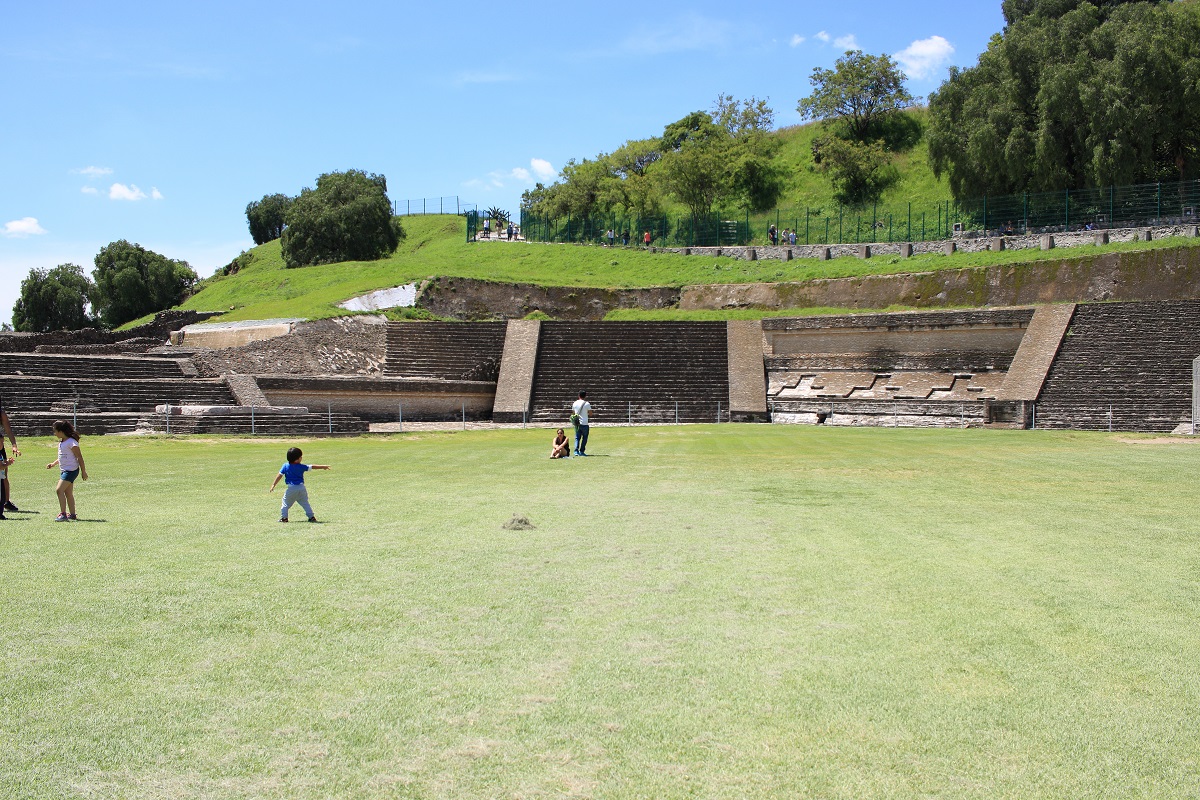
The great feature of Monte Alban is its size.  The city was created by leveling off the whole top of its mountain: the resulting flat grass plateau is vast, and the several pyramids anchoring it it like gargantuan building blocks utterly dominate the tiny figures of the tourists wandering below.  From a camera point of view these figures were excellent at establishing scale, though I wished I had wide-angle lens to really drive home the point.


I’ve come to the conclusion that one of the most appealing aspects of Mexico’s ancient ruins is their blend of massive architecture and grassland.  The grass is a modern addition of course, helpfully provided by nature and weedwhacked by the government, and Monte Alban in particular seems to be a perfect aesthetic blend of meadow, knoll, and temple stone.  It’s surprisingly pleasant to stroll a wide flat lawn looking up at great edifices emerging from moss and trees, to wander among them and climb their stone stairs for interesting views and a fresh country breeze.  I think modern cities should take a cue from these ruins.  Why shouldn’t soil, grass, trees and hills be the foundation of our own urban spaces?  I think the whole thing is applicable.


Sunday, August 6, 2017

The Cholula Pyramid and Authenticity

Yesterday I took a day tour from Puebla to see the “Pyramid” of Cholula.

Don’t expect much in the way of description for Puebla, gem of the Mexican guidebooks as it may be.  I cruised in and out with barely a glance and a lot on my mind.  I wore out the stone sidewalk for the three blocks between my hotelroom and the city center where the necessary restaurants and coffeehouses were clustered, and didn’t have the time to look further.  Also in the Centro, I did notice, was a mighty 16th Century cathedral, a stroll inside of which (where photos were prohibited) revealed such a hangarspace worth of Baroque overdecoration that its astrally gilded dome could encompass a pillared cupola that itself could have contained my town church in Cornwall Connecticut.  At night, as I emerged strung out on caffeine from an all-day coffeehouse stint writing three blog posts, the cathedral was staging a music and light show in which they projected tie-dye colors, spinning pinwheels, shadow-forms of wing-flapping angels, and a melting Mexican flag on the ancient stone.  I didn’t approve.  But never fear, there were plenty of other grand old churches to choose from: in my immediate neighborhood there were at least five, and so many colonial buildings done up in pink-and-white zig-zag tile that you couldn’t use them as landmarks.

My memories of Puebla will likely be restricted to my bizarre hotel, the Meson San Sebastian.  From the street you enter a luxurious two-story flagstone courtyard, pillared and arched in creamy yellow and filled with plants, glass doors and patio tables.  But my room upstairs?  It had no lock on the door; instead they issue you a padlock and its key, which I could affix to the latch either inside or outside the door to close it.  The room had no windows, a very dim hanging ceiling light, and no desk; one of the frosted glass panels on the door was broken and Scotch-taped shut, and the toilet pull-chain broke while I was there.  But it had palatially high ceilings of old wooden beams, and rich red curtains that one pulled in front of the door at night to shut out the hall light, and the bed was comfortable.  It was essentially an aristocratic cell.


My padlock

I put “pyramid” in quotes because it isn’t one, or wasn’t one, or is or was several, or maybe none.  Whatever structure was there was abandoned circa 1100 and immediately overgrown, and by the time the Spaniards arrived even the natives thought of it as a green hill, an illusion that persevered well into the 20th Century (despite Porfirio Diaz running railroad tracks through part of it in the 19th).  When archeologists finally started acknowledging an underhill edifice their hyperbolic verdict apparently announced no less than four ancient pyramids one on top of the other dating back to 250 BC, with a total base circumference by far exceeding the previous earthly record-holder, notwithstanding which hoopla it has never been excavated and to this day presents to the eye the aspect of a green hill (with a colonial-era church on top).

I received this information from Carla, a petite and energetic brown-haired native tour guide walking between the seats on a huge tinted-window tour bus that pulled away from the curb in the Pueblo Centro with all of four tourists aboard.  Puebla apparently runs these things like subway cars, on a daily schedule no matter how few people sign up.  Because of me—and because the Mexican couple sat rows away—Carla was forced to deliver her lecture in two languages (Amit, the bearded young backpacking Israeli, being fluent in Spanish), but she handled it admirably, the more so because I had no interest in the pyramid, but was hoping only to get a good view of Popocatepetl from Cholula.  I got my first teaser view of the famous volcano from the bus window en route.


En route to the pyramid we stopped briefly at two of Cholula’s churches (as if Puebla hadn’t had enough).  The first was the Iglesia de San Francisco Acatepec, another example of that curious Mexican over-candied pullulation of ornament that bowls one over from a distance but, up close reveals itself to be a medley of sadly cartoonish babies.


Carla did explain, on her own, that if the interior appears somehow sup-par it’s because the whole thing is a reconstruction following a 1939 fire; one can stand at a roped-off door and see at the back of an alcove a tiny piece of the 16th Century original that survived (its cherub looked more aesthetically finished).

The second church was a local landmark called Tonantzin, noted because its exterior features images of saints with brown skin, a liberty apparently granted to the Indian builders so that their exploited race (which Carla referred to as “we”) could more readily identify with their religious overlords. 


The imagery was again primitive to my taste, which I tried conscientiously to expand, but when I admired the group of figures playing musical instruments Carla admitted that that whole section was a modern addition.

The pyramid is, it’s true, partially excavated, but its most impressive wall—which  one encounters first, walking the long tourist promenade from the big parkinglot hosting several tour buses—is a fake, commissioned by the government to lend popular validity to the mostly invisible site.

This part of the pyramid is fake

The vast majority of the Zona Archeologico is indeed still mostly a green hill, and we—I was circling it in company with Amit—were now newly cynical, distrusting any revealed block that looked too smooth or white.  At least there was a view of Popocatepetl in the other direction.


You can, however, quickly learn to appreciate modern engineering by taking the underground tour.  This follows a series of tunnels cut into the pyramid by the various archeology teams to, I believe, initially verify that it wasn’t just a hill.  In my search for authentic stone I momentarily forgot that I don’t like being underground in small spaces; once in, there was nothing for it but to inch forward in an endless single file of tourists through an arch-shaped tunnel into the earth barely head-high and too narrow for anyone to turn around and squeeze backward.  I tried to breathe steadily whenever the Japanese group ahead brought the whole line to a stop for selfies.  And I never loved electric lights, sturdy metal floors, and ventilation so much.  To be fair, I think that even those without my affliction would find the unvaried stone to either hand uninteresting.

What is authenticity?  What makes an original “better” than a copy?  If we, uneducated laymen, can’t tell the difference, why does it matter?  Given that history, and perhaps all of culture, is a story we tell ourselves, why shouldn’t we—edit it? 

I think it all boils down to expectations.  We visit an ancient ruin to experience a window to the past, and we want to see the past.  If it isn’t the past, it’s a fraud.  We look at a famous painting to experience supreme artistic creativity; if it’s a copy—if it’s not creative—it’s likewise not what we paid to see.  In contrast, the replica of “Lucy” at the National Museum of Anthropology didn’t bother me, because its purpose in the room was to illustrate the idea of evolution, along with the various dioramas; I wasn’t told it was the original.

Mexico is a country bubbling in a constant convection with its own pasts, wrestling with its depredations, interpreting its victimizations, wary of the “authentic” in ethnicity and worship, honoring its ancient stone as it boasts of its steel and glass, unleashing every kind of constructive and destructive creativity in an effort to stitch its fractured national story together.  Maybe what we think of as the genuine is only the unifying fiction most victorious in the bloody marketplace of ideas.  It was a long climb from the tunnel mouth to the church at the top of the hill, and Amit and I didn’t have much time before the tour bus left.  But from there one could at last clearly see the unimpeachably, the perfectly, the beautifully and eternally authentic:


Ironic that it’s a dangerous volcano, currently closed because it’s too active.


Friday, August 4, 2017

A Day in Tepoztlán - Hike to Tepozteco / the Dominican Ex-Convent

The town of Tepoztlán, where I spent two nights and a day at the home of my friend Adrian Smith, is a small colonial-era village nestled in a spectacular mountain setting, about an hour South of Mexico City.

The dramatic mountains of Tepoztlán seen from
the mirador of the Dominican Ex-Convent

It’s listed as a “Pueblo Magico,” one of Mexico’s officially charming towns, but its hold on the certificate has been slippery, perhaps reflecting my feeling that its charm was skin deep.  Like many colonial towns or neighborhoods it features narrow, cobbled streets (nightmarish for traffic or low-slung cars), fronted on each side by a lineup of colorful shops and enticing restaurants, with, in the center, a beautiful central plaza around a venerable church (in this case a Dominican ex-convent).  As the town rises toward the foothills the streets become rockier and steeper, and they’re not short on hanging flowers and pretty perspectives, especially with that green-clad cliff-lifted wall of mountains ever in the background.  But a closer look reveals that many of the buildings are of cheap cement-block or brick construction, and overall I felt a dusty pall of makeshift poverty hovering behind the facades.


That didn’t stop it from being a wonderful place to stay and to explore.  It helped that with Adrian’s guidance I was taken to some of the loveliest restaurants, like La Miga in a shady garden of ranch-style buildings where everyone seemed to be friends, or El Corazon de Mexico with its outdoor tables rocking on the cobblestone courtyard and its tasty Mole dishes.  On our first evening we stumbled into an event in the town square where a festive crowd was setting aloft a homemade fire balloon.


Tepozteco

But the star attraction of the town, which occupied most of my full day there, is Tepozteco, a small Aztec temple high in the mountains, reached by a steep and arduous hike on a trail that starts a mile or so North of town.

I began my hike in the morning, walking uphill through the narrow streets, helpfully guided by signs for the pyramid.  The trail got progressively more primitive from there: starting in a leafy enfilade of last-chance vendors, it climbed through the greenery first in well-built stone stairways; then, more steeply, in narrow tracks of broken rock where you had to place your feet carefully; finally, funneled into the last niche-like gorge, straight up on a system of metal ladders hammered into the rock.


The tourists were plentiful, and at 7,000 feet the combined gasping added humidity to the hot jungle around us.  But every step was accompanied by the relief of gorgeous patterns of sun and green shade and, above and below, appalling vistas of the rock-clawed shafts of the mountain from black gorges to sun-laureled brows.  And finally (ta-ra!) the temple appeared.


The pyramid was relatively small, a mountain-ridge fort easily clambered, but the view from it was large, to say the least.


It was worth staying for a while, in the welcome breeze, before essaying the long downward trail.

The Dominican Ex-Convent


After lunch back in town (where hopefully my sweaty presence didn’t disturb the colorful Mexican ambience) I headed over to the main church, the Dominican ex-convent or Parroquia Nuestra Señora de la Navidad.  Its entrance boasts some lovely bas-relief figures and Dominican insignias, and inside one finds a typically tranquil convent courtyard of white arches around a central fountain—a pleasant place to rest my still-sore feet, with a rare corner vantage suitable for self-timer photos.


The convent, like others I’ve seen, has restored its once-covered trove of original 16th-Century wall decorations—in this case curious patterns featuring the heads of kings in (and extending from) floral designs.  I’m not sure what to make of those.


But in Tepoztlán everything leads back and up to the mountains, and the highlight of the church was its mirador room, an open-air gallery whose arched windows framed the eternal green glory of the landscape.


There was a gentleman occupying the mirador with a telescope pointed at the Tepozteco pyramid, from here a microscopic square breaking the cauliflower crust of the distant jungly ridge.  I didn’t need to look.